Posts

Showing posts with the label Dharma Ending Age

The World Is Not Degenerating — We Are Not Seeing Clearly

Image
Rohitassa Sutta, Dzogchen, and Pure Land Echoes In the  Rohitassa Sutta  (Saṁyutta Nikāya 2.26), the Buddha makes a revolutionary statement that challenges our assumptions about the world, suffering, and liberation: " In this very fathom-long body, with its perception and mind, I declare is the world, the origin of the world, the cessation of the world, and the path leading to the cessation of the world. " This “fathom-long body” — roughly the height of a person, from fingertip to fingertip — is not just the locus of personal identity. It is, in the Buddha’s words, the world itself. This is not a metaphor. It is a radical pointing out that the entirety of our suffering and the path to its end is found within our own mind-body system — perception, feeling, intention, consciousness. So, when people say we are in the Dharma Ending Age, that the world is falling apart, we may ask: What exactly is ending? Is the Dharma itself fading? Or is it our ability to see the Dharma that...

Leader or Guide?

Image
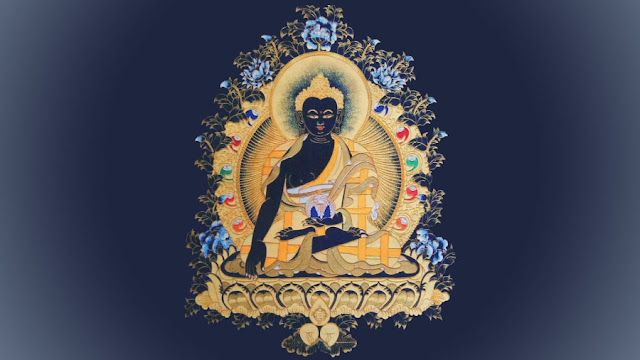
Upali lived during the time of Buddha and was the follower of another religion and went to the Buddha in order to argue with him and try to convert him. But after talking to the Buddha, he was so impressed that he decided to become a follower of the Buddha. But the Buddha said: “Make a proper investigation first. Proper investigation is good for a well-known person like yourself. “Now I am even more pleased and satisfied when the Buddha says to me: ‘Make a proper investigation first.’ For if members of another religion had secured me as a disciple they would have paraded a banner all around the town saying: ‘Upali has joined our religion.’ But the Buddha says to me: Make a proper investigation first. Proper investigation is good for a well-known person like yourself’.” (Majjhima Nikaya 2.379) * * * * * * * I sometimes use the Amitāyus Sādhana as a practice during mini-retreats. The Amitāyus Long Life Mantra is  om amarani zewänteye söha .  This...

Living With Fools

Image
Asevana ca balanam panditanañca sevana,  "Don't associate with fools. Associate only with wise people." "Fools" are people whose minds and actions are unskillful and "evil". They are unskillful in their actions - killing, stealing, having careless sex - and unskillful in their words: telling lies, creating disharmony, deceiving other people, engage in gossip. They are unskillful in their thoughts - judging others, conceptualizing, lost in drunken fantasy. Fools are the enemy of society because unskillful behavior makes us the enemy of society. Gossiping, for example, makes us the enemy of those we tell tales about, enemies of the persons we share our filth with, enemies of ourselves as we spew our half truths and lies. That's one example of a fool. Serving one's self over serving others is yet another. Being willing to harm others is one of the prevalent   examples of foolishness in the world today. The foolishness of feeling mo...

On Being Overwhelmed

Image
Being Overwhelmed The Buddha taught that I person willing to hate is willing to commit any atrocity. He called it an “evil mind”. It corrupts all of our motivations, even those that are quite honorable. Hatred creates in us the ultimate narcissist.   It broods the illusion in the mind of the angry hater that their views, opinions and beliefs are so important that everyone must listen and obey them and believe as they believe. “He who hates his brother is a murderer and a murder does not have eternal life.” The line is from 1 John 3:15 in the New Testament, the Christian Dharma. I used it in an interfaith teaching not long ago. I was admonished by a couple of ministers who were also presenting who told me that John, the spokesman for God in this case, meant this verse only to refer to hating Christian brothers and not persons outside that faith. So, is it okay to hate everyone else? It seems a legalist interpretation of a universal truth. Unfortunately, I have heard s...

Rational Amidism: Prayer

Image
I am often asked if Buddhists, any Buddhist, believe in a Supreme Being analogous to the Western God. My answer is always, “No, we don’t. If any sect proclaims an original anything then they are not Buddhist.” Clearly, belief in a first cause is an anti-Buddhist idea, according to the words of the Buddha himself. The question then arises, “Who do Buddhists pray to?” Having been originally trained as Theravada Buddhist monk the word and idea of “prayer” was not altogether alien to me, but I hadn’t formally prayed since I was 11 years old. I don’t remember praying after that. I had some hopes and aspirations and would say things like “I hope” such and such happens or doesn’t happen; but I am not sure if that qualifies as “prayer” in the Western sense. I was just throwing it out there to the universe — but was this a prayer, an aspiration or just a hope? Because we in the West are mainly new converts to Buddhism we avoid the term “prayer: as much as possible. It’ s a word too...

Surangama Sutra and Synthetic Dharma

Image
The Śūraṅgama Sūtra has the impossibly long title of “The Sūtra on the  Śūraṅgama  Mantra Spoken from above the Crown of the Great Buddha's Head, and on the Hidden Basis of the Tathagata's Myriad Bodhisattva Practices Leading to Their Verification of the Ultimate Truth.” It never quite lives up to the title – but what could? The title alone seems to promise great wisdom or great confusion with its talk about myriad practices, verification and ultimate truth. So where did this jewel of Mahayana come from? No one knows for sure but some intelligent guesses can be made. The Buddha is not on the list of likely suspects. The first person that gave an account of the  Śūraṅgama Sūtra  was Zhi-sheng, a Chinese monk of the  Tang Dynasty . Zhi-sheng said this book was brought back from Guangxi to Luoyang  during the Kaiyuan era. He gave two different accounts of its travels in two different books of his, both of which were published in 730 CE. First he s...